NEWS
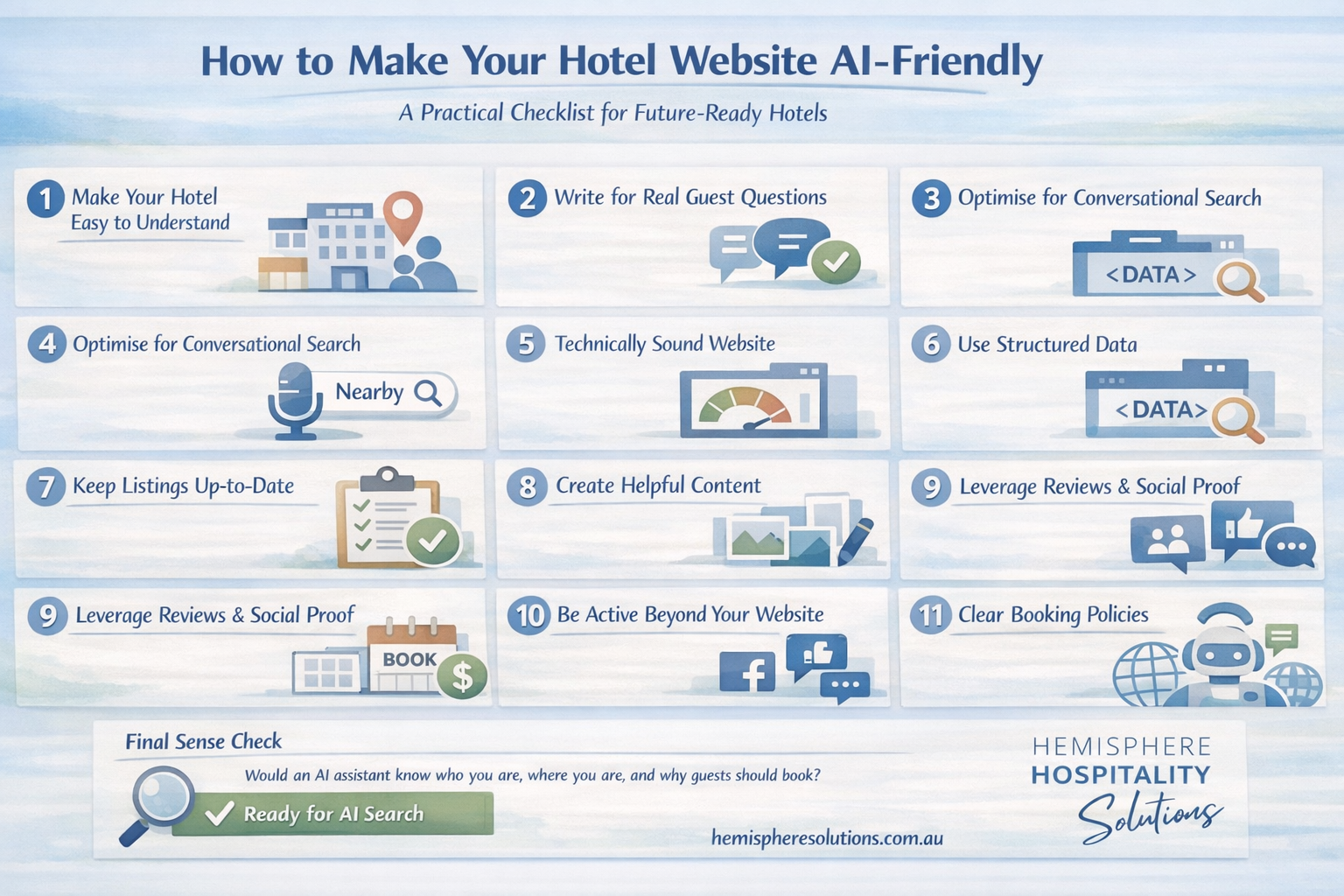
How to Make Your Hotel Website AI-Friendly
A Practical Checklist for Future-Ready Hotel Websites
AI-powered search, voice assistants, and generative travel tools are rapidly changing how guests discover and choose accommodation. An AI-friendly website helps your hotel be understood, trusted, and recommended — not just ranked.
Use this checklist to assess how well your hotel website is positioned for AI-driven discovery and bookings.
1. Make Your Hotel Easy to Understand
☐ Clearly explain what your hotel is, where it is, and who it’s best for
☐ Use plain, conversational language rather than industry jargon
☐ Ensure each page has a single, clear purpose
☐ Avoid vague marketing copy — be specific and descriptive
☐ Clearly differentiate accommodation, dining, events, and experiences
2. Write for Real Guest Questions
☐ Include content that directly answers common traveller questions
☐ Use question-and-answer formats where possible
☐ Address practical considerations such as:
Parking
Distance to key locations
Accessibility
Breakfast and dining options
Suitability for families, couples, or business travellers
☐ Make answers easy to scan and understand
3. Optimise for Conversational & Voice Search
☐ Write content as guests would speak it aloud
☐ Include natural phrases such as “near”, “best for”, “close to”, and “easy access”
☐ Use full sentences rather than keyword stuffing
☐ Include local references and nearby landmarks naturally
4. Strengthen Your Hotel’s Digital Identity
☐ Use consistent hotel name, address, phone number, and contact details everywhere
☐ Clearly describe your location beyond just a street address
☐ Maintain a strong, consistent brand voice across all pages
☐ Ensure imagery reflects the real guest experience
☐ Clearly state your positioning (luxury, boutique, leisure, corporate, lifestyle)
5. Ensure Your Website Is Technically Sound
☐ Fast loading times on desktop and mobile
☐ Mobile-first design and navigation
☐ Secure website (HTTPS enabled)
☐ Clean site structure that search engines can easily crawl
☐ No outdated, broken, or hidden pages
6. Use Structured Data to Help AI “Read” Your Site
☐ Implement structured data for your hotel and accommodation
☐ Clearly define room types, amenities, and inclusions
☐ Mark up FAQs, offers, and reviews where relevant
☐ Ensure check-in, check-out, and location details are machine-readable
☐ Regularly test and validate structured data
7. Keep Your Online Presence Current Everywhere
☐ Website content is updated regularly
☐ Offers and packages reflect current availability
☐ Old promotions and expired messaging removed
☐ Business listings across platforms are accurate and complete
☐ Photos, amenities, and descriptions remain current
8. Create Helpful, Experience-Led Content
☐ Publish content that helps guests plan their stay
☐ Include local guides, events, attractions, and itineraries
☐ Focus on experiences, not just rooms
☐ Update content seasonally
☐ Write content that AI tools can easily summarise and reference
9. Leverage Reviews & Social Proof
☐ Display guest reviews directly on your website
☐ Encourage detailed reviews that mention experiences and facilities
☐ Respond to reviews professionally and consistently
☐ Showcase awards, ratings, and affiliations
☐ Avoid generic testimonials — use real guest language
10. Be Active Beyond Your Website
☐ Maintain consistent branding across social media platforms
☐ Share useful, experience-based content (not just promotions)
☐ Use location tagging and descriptive captions
☐ Engage authentically with travellers online
☐ Ensure public content reinforces your positioning and credibility
11. Improve Booking & Policy Clarity
☐ Booking calls-to-action are clear and consistent
☐ Pricing and inclusions are transparent
☐ Cancellation and payment policies are written in plain English
☐ Booking engine is easy to navigate on mobile
☐ No surprises or hidden conditions
12. Prepare for AI-Driven Guest Interaction
☐ Website content can support AI chat or virtual assistants
☐ FAQs and policies are structured for easy AI use
☐ Consider multilingual content for key markets
☐ Clearly communicate sustainability, accessibility, and inclusivity
☐ Ensure information is reliable, current, and trustworthy
Final Sense Check
Ask yourself:
If an AI travel assistant had to recommend your hotel in one sentence, would it clearly understand who you are, where you are, who you’re best for, and why a guest should book?
If the answer is yes — your website is on the right path.